Villa Interior Design in Dubai: How to Write a Brief That Delivers
Nearly 6,000 prime residential transactions above AED 10 million were recorded in Dubai in 2025, and villas accounted for 70% of them. Yet the most common reason these projects disappoint has nothing to do with budget. It comes down to the brief.
12 October 2026 · 17 min read · K4 Fit-Out Studio
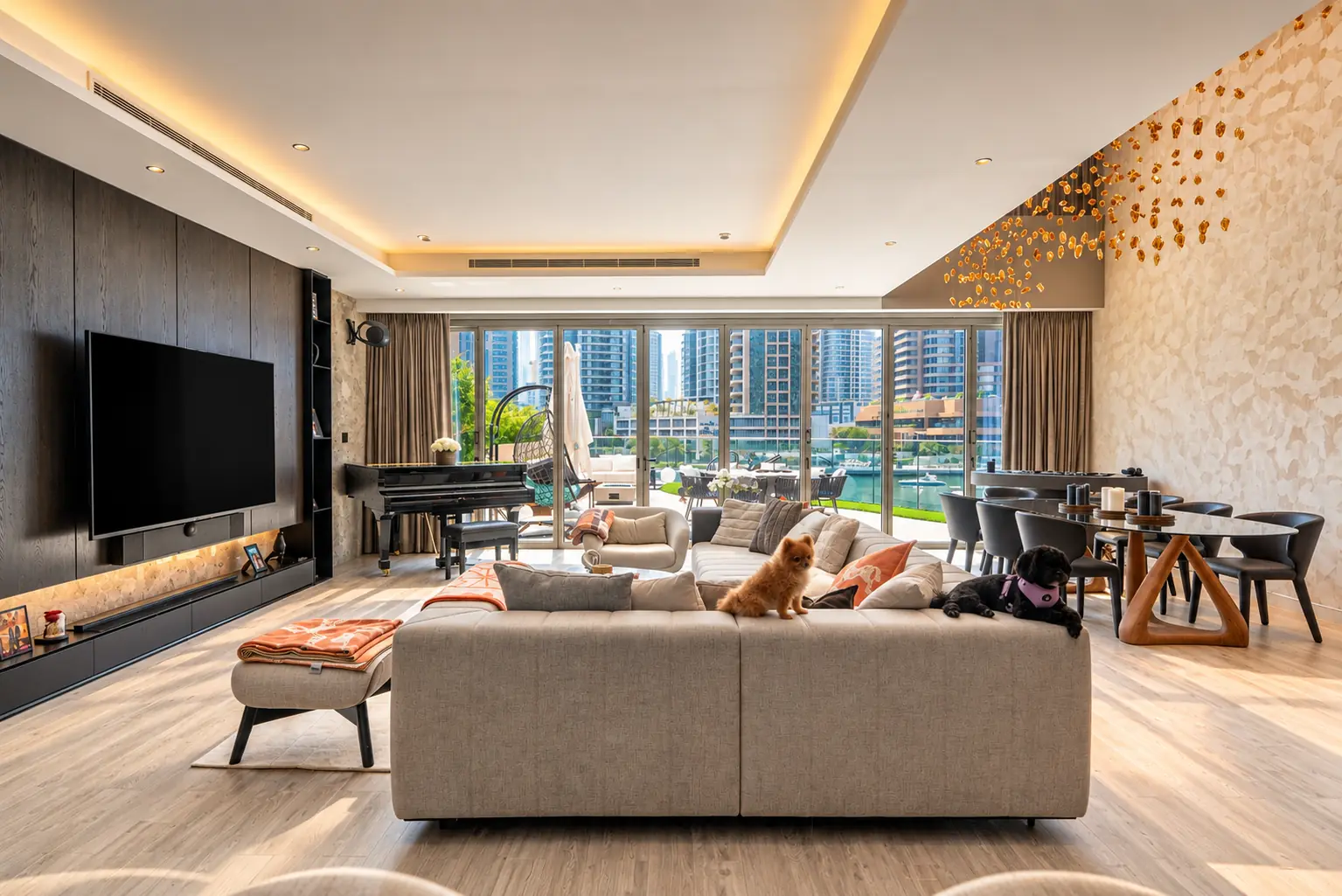
Villa interior design in Dubai has matured considerably. The maximalism that defined the 2010s has given way to quiet luxury, curated material palettes, and spaces that reward restraint. UHNW buyers now expect precision: travertine, limestone, warm oak, organic silhouettes, and interiors that perform as well as they photograph. Delivering that level of outcome requires more than a talented fit-out team. It requires a structured, detailed brief that gives that team everything they need before a single sample board is produced.
This guide walks you through exactly how to build that brief. You will learn how to audit your lifestyle, establish spatial hierarchy, set climate-appropriate material standards, tailor your approach to Palm Jumeirah, Emirates Hills, or MBR City, and document handover expectations with the same rigour as your design specification. The brief is where great villa projects are won or lost.
Why the brief determines the outcome more than the budget
With villas representing 70% of prime volume, the financial stakes of getting a villa fit-out right have never been higher, and the penalty for getting it wrong is proportionate.
The most common cause of disappointment in luxury villa fit-outs is not an inadequate budget. It is a vague or incomplete brief. When intent is not documented, the fit-out team fills the gaps with interpretation, and interpretation at scale is expensive to correct. A project worth tens of millions of dirhams should not depend on assumptions.
A structured brief is not a mood board or a folder of magazine references. It is a formal document built around four pillars: how you live, how the villa should flow, what material standard is acceptable, and what a successful handover looks like. Each pillar answers a different question for a different discipline. Aesthetic references are a starting point, not a substitute for this structure.
Fragmentation compounds the problem. Clients who engage separate architects, interior designers, and contractors without a shared governing document create the conditions for cost overruns and timeline drift. Without a single brief that every party works from, decisions made at design stage get contradicted at fit-out stage, and the client pays for the resolution each time.
The numbers give this urgency a precise shape. All-in villa commissions in Dubai, covering construction, fit-out, furniture, art, and landscape, range from AED 35 million to over AED 100 million. Delivery timelines run from 22 to 36 months. Understanding what a luxury villa renovation in Dubai actually costs is part of the picture; knowing how to protect that investment once committed is the other part. At this scale and duration, brief clarity at the outset is the single highest-leverage action available to any client. Every ambiguity resolved before design begins eliminates a disproportionately larger cost if it surfaces during construction.
The sections that follow set out exactly how to build that brief.
What a strong brief actually contains
A strong brief is structured around four pillars, each serving a different discipline on the project.
- Lifestyle audit answers how you actually live: who occupies the villa, how often, and with what daily routines. This data governs the interior designer's decisions at every scale.
- Spatial hierarchy answers how the villa should flow and which zones command the highest specification. It governs the architect and fit-out team's decisions about where quality concentrates.
- Material specification answers what standard of finish is acceptable, down to grade, origin, and tolerance. This governs procurement and joinery production.
- Handover expectations answer what a successful completion looks like, covering snagging protocols, warranties, and operational documentation. This governs the project management and sign-off process.
The most common brief failure is the inverse of this structure: clients arrive with extensive aesthetic references, Pinterest boards, magazine tearsheets, and sample imagery, while leaving the operational layer entirely undocumented. The number of full-time residents, entertaining frequency, live-in staff requirements, security protocols, and climate control zones are the data points that determine whether the interior designer and fit-out team can actually execute the vision. Without them, the team is interpreting intent rather than following instruction, and interpretation is where costs and disappointments originate.
For our divisions handling Dubai villa design projects above AED 10 million, the brief is not a document the client prepares in advance and hands over at the first meeting. It is produced collaboratively during a formal discovery session, where the fit-out partner brings district-specific knowledge, material expertise, and operational experience to the table. A pre-written brief submitted without that collaboration almost always contains gaps the client did not know existed. Our separate guide on how to brief a design and build firm in Dubai covers the day-one information any firm will ask for.
Step 1: Conduct a rigorous lifestyle audit before any design conversation
The lifestyle audit is the first pillar of the brief, and it must be completed before any design conversation begins. Its purpose is simple: to give the fit-out team an unambiguous picture of how the villa will actually be used, by whom, and how often.
Start with occupancy. Document every category of resident: full-time household members, seasonal users, and regular guests. A family of four with two live-in staff members has a fundamentally different spatial brief from a couple who entertain at scale but occupy the villa as their sole residence. These are not variations on the same brief; they require different room configurations, separate circulation routes, and distinct levels of staff infrastructure.
Map daily routines across the entire household. Morning rituals, working-from-home requirements, children's study and play zones, evening entertaining, and fitness use each carry a spatial consequence. A principal who video-conferences daily from home needs a dedicated, acoustically resolved study, not a corner of the master bedroom. Capturing these routines in writing, before the brief reaches the interior design and fit-out team, prevents the designer from resolving them through assumption.
Identify the hierarchy of entertaining explicitly. Formal dining for twelve, informal family meals, poolside gatherings, and private staff catering are not served by the same kitchen, the same dining room, or the same service route. Conflating them in the brief produces spaces that serve none of these functions well, and correcting that in fit-out is expensive.
Document wellness requirements with precision. In contemporary modern villa projects across Dubai, spa facilities, gyms, wine cellars, home cinemas, and integrated outdoor living have moved from prestige features to genuine architectural requirements. The distinction that matters in the brief is whether each space is a daily-use room or an occasional amenity, because that changes structural loadings, ventilation specifications, and finish standards.
Record occupancy rhythms and travel patterns. A villa occupied for three months annually demands different climate resilience, smart home automation, and maintenance protocols than a full-time primary residence. These factors directly affect material selection, MEP specification, and the scope of handover documentation, and they cannot be retrofitted once procurement begins.
Step 2: Define spatial hierarchy so every room has a clear purpose and priority
Once the lifestyle audit is complete, translate that data into a ranked, written spatial hierarchy before a single design drawing is produced.
This matters acutely in the current Dubai market. Quiet luxury has become the dominant aesthetic register across home interior design projects in Dubai, and quiet luxury depends entirely on contrast: knowing which spaces should command and which should recede. A principal reception that pulls focus is only possible because the corridor leading to it does not. It is one of the decisions that separate a genuinely luxurious interior from a merely expensive one.
Tier your zones in writing
Document three tiers explicitly in the brief.
- Primary zones require maximum specification across every category: materials, lighting design, acoustic treatment, bespoke joinery, and hardware. The master suite wing, principal reception, and chef's kitchen belong here without exception.
- Secondary zones include family living areas, guest suites, and home office spaces. These should be finished to a high standard, but with deliberate simplification relative to primary spaces. That calibration is a brief instruction, not a design decision made later.
- Tertiary zones cover service corridors, utility rooms, and staff quarters. A clear but differentiated finish standard applies. Specifying this in the brief prevents over-investment in spaces that do not affect the client experience, and under-investment that creates maintenance problems at handover.
Do not default on circulation
Entrance halls, gallery corridors, and stair volumes are consistently under-briefed in villa interior design projects in Dubai, yet they govern the entire emotional sequence of moving through the home. The arrival experience is formed in transition, not in the rooms themselves. Our completed villa projects illustrate how considered circulation transforms a villa's sense of arrival. Assign each transition space to a tier and specify accordingly.
Hierarchy governs material flow
Spatial hierarchy also determines where materials change. Deciding where travertine gives way to oak, where linen wall panels replace plaster, and where bronze hardware transitions to a simpler finish are brief-level decisions. Left to design stage, these transitions become arbitrary. Fixed in the brief, they become the logic that makes the interior coherent.
Step 3: Set material standards that account for Dubai's climate, not just the showroom
Once spatial hierarchy is resolved, the brief must address a distinct but related question: not just which materials, but which grade of each material, and whether it will perform in Dubai's climate over a ten-year horizon, not just in a supplier's showroom.
The quiet luxury palette (travertine, limestone, oak, walnut, linen, bouclé, bronze) is specified on projects worldwide. What changes in Dubai is the performance layer that must sit beneath every aesthetic choice. UV exposure at this latitude degrades natural textiles and unprotected timber finishes faster than comparable climates in Europe. Humidity cycling between air-conditioned interiors and outdoor heat creates expansion stress in stone joints and timber veneer. These are not hypothetical risks; they are predictable failure modes that a well-prepared brief eliminates by requiring climate-specific performance criteria alongside aesthetic ones.
Waterfront locations require additional scrutiny. For Palm Jumeirah villas, the brief should mandate a salt-spray resilience audit covering all external-facing materials and any material specified within ten metres of an open elevation. Bronze hardware, natural stone copings, and external joinery are all vulnerable. This audit belongs in the brief, not in a procurement conversation six months into the project.
Specification depth separates outcomes. Writing "travertine" in a brief is not a specification; it is a category. Travertine prices vary widely across grades, origins, and surface treatments, a difference the brief must define explicitly to give procurement a meaningful quality benchmark. The same discipline applies to every material category: limestone, oak veneer, and woven wall coverings all carry grade and origin variables that produce meaningfully different results. Our guide to marble and stone selection in Dubai villas goes deeper on this.
Joinery demands the same rigour. Bespoke joinery is typically one of the largest single cost lines in a luxury villa fit-out. The brief should specify veneer origin and leaf-matching method, substrate material, hardware weight and finish, and dimensional tolerance standards. These parameters give the workshop an unambiguous quality benchmark and give the project manager a basis for sign-off at each stage.
Sustainability requirements must be declared early. Low-VOC finishes, sustainably sourced timber, and materials aligned with WELL or equivalent standards are increasingly standard in briefs from globally travelled UHNW buyers. If these are requirements, they must appear in the brief before procurement begins. Substituting a specified material mid-project for a compliant alternative is disruptive and costly. Clients exploring villa opportunities in Dubai can review available residential properties to understand the range of locations where these brief requirements will apply before the fit-out conversation starts.
Step 4: Tailor the brief to your district
Material standards set the performance floor. Where your villa sits determines the specific tests those materials must pass.
Dubai's three dominant trophy districts, Palm Jumeirah, Emirates Hills and MBR City, each impose brief requirements that are architectural and environmental, not merely stylistic. Treating them as interchangeable is a brief error with lasting consequences.
Palm Jumeirah (AED 19.38 billion, 31% of the trophy market)
The brief must be view-led before it is anything else. Principal room orientation, glazing specifications, window-to-wall ratios, and external living zones must all be resolved at brief stage. A waterfront villa that fails to maximise its water outlook has a permanent deficiency that no interior finish can correct. Beyond the view, every material within ten metres of an open elevation requires mandatory salt-spray testing; this is a brief parameter, not a procurement afterthought.
Emirates Hills (AED 9.04 billion, 15% of the market)
The district carries a classical register that demands formal ceremonial planning. The brief should document the full arrival sequence, the separation between formal and informal reception zones, symmetry expectations across principal elevations, and the precise degree to which traditional material references (stone, brass, dark timber) are to be honoured or deliberately subverted. Inland positioning also introduces persistent fine dust; the brief should specify filtration standards for all climate systems.
Mohammed Bin Rashid City (AED 6.40 billion, 10% of the market)
MBR City's contemporary architecture carries higher smart home integration requirements than either established trophy location. The brief should include a KNX or equivalent home automation specification covering lighting scenes, climate zoning, security integration, and audio-visual distribution, agreed before interior design begins. Contemporary full-height glazing also generates significant solar gain; the brief must specify solar control glazing and internal shading systems as performance requirements, not design options.
District-specific requirements are performance parameters tied to physical environment, not aesthetic preferences. An experienced fit-out partner should introduce these to the brief during discovery. If yours does not, reviewing how a well-specified villa translates brief into outcome illustrates what that level of brief discipline produces in practice.
Step 5: Document handover expectations with the same precision as the design specification
District-specific brief parameters govern how the villa performs in its environment. Handover expectations govern whether what was built actually matches what was specified. Clients who are meticulous about documenting marble origins, veneer matching methods, and joinery tolerances will frequently accept a verbal assurance about snagging procedures and post-handover support. That asymmetry is where luxury villa projects most commonly unravel in their final weeks.
Snagging protocol belongs in the brief, not the conversation. Specify the number of formal snagging rounds included in the scope, define which defect categories trigger mandatory remediation before practical completion, and establish what the client acceptance process looks like for each principal space. Defects should be categorised from the outset: critical structural or safety issues, functional failures, and cosmetic deviations each carry a different remediation obligation. Under Dubai's construction framework, defects reported within the Defect Liability Period carry legal remediation weight, but only when formally documented. A brief that defines the snagging protocol gives that documentation process a clear structure to follow.
Operation and maintenance documentation is a project deliverable, not an afterthought. Every installed system should be covered: HVAC zoning, home automation, bespoke joinery with concealed mechanisms, specialist lighting, water features. The brief should require the fit-out partner to deliver a client-facing operation manual and a maintenance schedule for each system before handover is accepted. For luxury-specific installations where supplier documentation exists, the brief should require that documentation to be consolidated and handed over in a single reference package.
Warranty alignment must be resolved at brief stage. Document minimum warranty periods for each work category: structural, waterproofing, joinery, MEP, and finishes. Confirm the fit-out partner's subcontractor agreements reflect those periods before contracts are signed. The structural warranty period under Dubai's construction framework extends to ten years from completion; the Defect Liability Period covers up to twelve months for mechanical and construction defects. Discovering a warranty gap at handover is not a construction failure. It is a brief failure.
For investment and rental assets, add a dilapidations baseline to the handover section. A photographic and written record of the finished specification, prepared at handover, creates an unambiguous reference point for future tenancy management, dispute resolution, or eventual resale. For villas in the AED 10 million-plus segment, that record protects a material asset.
How a clear brief protects your budget and timeline
Documenting handover expectations with precision is one half of protecting your investment. The other half is understanding, in concrete financial terms, why brief clarity is itself a cost control mechanism.
A well-structured brief allows your fit-out partner to price against defined parameters. When scope is fully defined, estimators can apply a tighter contingency; experienced cost consultants in Dubai typically price ambiguity at a significant premium over well-specified projects. Vague briefs are not just inconvenient; they are expensive from the first page of the estimate.
Change orders are the primary driver of budget overruns in luxury villa fit-out, and peer-reviewed research on large-scale construction projects confirms that design changes contribute to 56.5% of cost overruns and 40% of project delays. The critical point is that most change orders do not represent genuine scope additions; they represent brief ambiguities that surface once construction is underway. A material substitution decided before tender costs a phone call. The same substitution decided after a wall is tiled costs remediation, reordering, programme adjustment, and re-sequencing of downstream trades.
Timeline protection follows the same logic. Decisions deferred to construction stage are far more disruptive than decisions made at brief stage, because the build programme has no slack designed in to accommodate them. Room function changes, spatial adjustments, and finish revisions each trigger a cascade through the programme that the original schedule was never designed to absorb.
Even a modest reduction in change-order volume on a project at this scale translates into a meaningful financial saving, and brief discipline is the most reliable mechanism for achieving it. Across the project scales typical in Dubai's trophy market, that saving is material.
This is where the turnkey model has a structural advantage. A partner whose project control function covers design, MEP coordination, joinery, fit-out, and construction under a single contract has every incentive to enforce brief discipline from day one. Any ambiguity in the brief becomes their problem to resolve, not a dispute clause to invoke against a separate party.
What to expect from your fit-out partner during the briefing process
Knowing that brief discipline protects your budget is only useful if your fit-out partner is equipped to enforce it. The partner's conduct during the briefing process is therefore as consequential as the brief itself.
A partner who accepts a vague brief without challenge is not serving your interests. A capable fit-out team will open the engagement with a structured discovery session that moves systematically through each brief pillar: lifestyle audit, spatial hierarchy, material standards, district-specific requirements, and handover expectations. If a partner skips this process and proceeds directly to concept visuals, treat that as a qualification signal.
The discovery session must conclude with a written, client-approved document. No verbal agreement is enforceable.
District knowledge is not a bonus; it is a baseline competency. For any home interior design project in a primary Dubai location, your fit-out partner should arrive at the briefing session already fluent in Palm Jumeirah's view-led planning constraints and salt-spray material requirements, Emirates Hills' authority requirements and classical planning conventions, and MBR City's developer guidelines and smart home integration expectations. You should not be educating the partner on these parameters; the partner should be adding them to your brief.
Expect the brief to remain visible throughout the entire project. Every concept presentation, design development drawing, material sample board, and MEP specification should be traceable back to a named brief parameter. If a design proposal cannot be justified by reference to the brief, it is either a gap that needs to be addressed or a scope addition that requires a formal client decision. Proposals that exist in isolation from the brief are a structural risk, not a creative contribution.
At K4 Group, project management through the fit-out process begins at the discovery stage. The briefing session covers all four pillars and concludes with a client-approved document that governs every subsequent stage from concept through to handover, providing the unambiguous mandate that a project of this scale requires.
A brief is the most valuable document your villa project will produce
The four pillars are not sequential tasks to be completed and set aside. Together they give every discipline on the project an unambiguous mandate rather than a set of assumptions.
Brief discipline, not raw budget, is the primary predictor of whether a project delivers the home the client envisioned.
The single most useful action you can take before any design conversation is to draft a brief. It does not need to be polished. A rough document covering your household's daily routines, the rooms that matter most, the material standard you consider acceptable, and what a successful handover looks like will force a quality of thinking that separates clients who receive the home they envisioned from those who accept the home they were given.
Verify that your fit-out partner treats the brief as a formal, written deliverable, one that every subsequent stage of the project must be traceable back to.
For any villa owner or buyer ready to translate a vision into a structured brief governing a project worth tens of millions of dirhams, K4's discovery process begins precisely here. The discovery conversation covers all four pillars, produces a client-approved brief document, and establishes the mandate that carries the project from the first design sketch through to handover.
Conclusion
A well-constructed brief is not a formality; it is the foundation that determines whether your villa becomes the home you envisioned or a costly compromise. The core lessons from this guide are clear: your lifestyle drives the design, spatial hierarchy gives every room purpose, material standards must account for Dubai's climate, and handover expectations deserve the same precision as the design itself.
Projects that begin with a rigorous brief consistently deliver stronger results, protect budgets, and reduce timeline risk. The investment of time made at the briefing stage repays itself many times over during construction, procurement, and snagging.
If you are ready to move from vision to a structured plan, start by drafting your brief today. Even a rough document transforms how you engage every consultant on your project. Your villa deserves that clarity from day one.
Frequently asked
What should a villa interior design brief in Dubai include?
Four pillars: a lifestyle audit (who lives in the villa and how), a ranked spatial hierarchy, a material specification down to grade, origin and tolerance, and documented handover expectations covering snagging, warranties and operation manuals.
Why does the brief matter more than the budget on a luxury villa?
Most change orders are brief ambiguities surfacing during construction. Design changes drive a large share of cost overruns and delays, so resolving intent in writing before design starts is the most reliable form of cost and programme control.
Do Palm Jumeirah, Emirates Hills and MBR City villas need different briefs?
Yes. Palm Jumeirah briefs must be view-led with salt-spray material testing, Emirates Hills briefs need formal arrival planning and dust filtration, and MBR City briefs need a home automation and solar-control glazing specification agreed early.
What warranty periods should a villa fit-out brief document?
Minimum warranty periods per work category: structural, waterproofing, joinery, MEP and finishes. In Dubai the structural warranty extends to ten years from completion, and the Defect Liability Period typically covers up to twelve months.